Showing posts with label Keratitis. Show all posts

Saturday, 19 March 2016

You should Immediately Stop Doing this with Contact Lenses


Contact lenses are medical devices that need meticulous care & handling. Failing to follow the instructions provided by your contact lens provider and medical experts, may lead to ocular infections & in some cases permanent blindness. The gross factor responsible for most of the contact lens induced infections is “water”. Water carries a microorganism that clings itself to the cornea and begins feeding on it. Acanthameoba Keratitis is too quick to even let you realize and is known to devour the human cornea in a small period of 24 hours. Stop being careless with your contact lenses & make your best efforts towards hygiene.

Contact lenses are handy accessories that help transforming the color & maintain crisp visual acuity. More than 30million people wear contact lenses alone in the United States and seldom do the doctors report contact lens related infections. This proves, that contact lens induced infections are almost rare which makes contact lenses safe to wear, provided they are FDA approved. As per experts, it is not contact lenses that should make people feel afraid of, but the poor attitude of the consumers towards circle contacts.

Why Water is Poisonous for Contacts?
Since water is not salty like tears, it gets absorbed by contact lenses. Due to the absorption of water, contact lenses swell and helps bacteria to dwell. The water borne micro-organisms than feed on corneal tissues and may lead to the permanent blindness by eating the eye ball within few hours.


If you are stuck in a situation where you have no supply of contact lens solution or a case to disinfect and store your lenses in then the best bet for you is to throw them away. Your eyes are too important to take a risk for. Never try rinsing them with water or saliva as both of these are ridden with bacteria.
A recent University study shows that Keratitis can stay longer in the disinfectant than previously thought. Therefore, be very diligent with your contact lenses to prevent the damage. Remember the drill i.e. washing your hands with a soap before touching your contacts to rub, rinse & disinfect your contact lenses using a multi-purpose solution.


Keratitis causes irritation and inflammation of the cornea and may lead to permanent vision loss if not treated correctly. Always remember pre-school lesson that prevention is better than cure. Don’t be repulsive about contact lenses but your lousy approach. Modern day contacts are made with keeping health standards into considerations and European CE certification further approves them for being safe for consumers. If you still suspect contact lens related discomfort; stop wearing them and immediately rush to an eye doctor for a complete diagnosis. Probably, you have ignored few of the contact lens care instructions!

Saturday, 21 March 2015

Contact Lens Wearers at Risk of Infections due to Unhygienic Practices


A recent warning released by eye experts reminds contact lens users to stay vigilant about proper care of contact lenses. Doctors reveal that there have been an increased number of patients in past months that are affected by infections occurred by improper use of contact lenses.

Infections Contact Lens Wearers are at Risk Of:


Acanthamoeba Keratitis


Acanthamoeba Keratitis is a microorganism carried by water. When users wearing contact lenses carelessly use water whilst wearing lenses; they get affected by the infection. This microorganism is corneal devouring bacteria & in gross cases it may lead to complete visual impairment. Eye experts advise to completely avoid water-related activities before handling contact lenses. Do not wash face, do not visit beach & do not take baths when wearing circle lenses.

Conjunctivitis


It is the inflammation of conjunctiva- the white layer of the eye. Contact lens wearers spread conjunctivitis when they share, swap or exchange contact lenses among fellow wearers. It is diagnosed by teary eyes, pink eyes, itching, irritation & discharge. When contact lenses are contaminated with bacteria, they should be immediately thrown away and or replaced. Avoid wearing circle lenses when suffering from infection to prevent spreading the disease.

Doctors opine that patients should keep an eye over how their eyes are working with contact lenses. In case of any unusual symptoms such as inflammation or excessive discharge from eyes; rush to your eye doctor than creating panic. To stay on the safe side, never top off contact lens solution but always toss it off and refill the chambers after each wear.


Contact lenses need meticulous care as they are prosthetic medical devices. Provided what you get for your eyes are FDA approved lenses there are rarely any chances for you to get affected by contagious ocular diseases. 

Tuesday, 18 November 2014

3 Ways you are Wearing Contact Lenses Wrong: First Contact Lens Week, 2014 (Health Reminder 2)

Play your role in prevention against conjunctivitis, keratitis & neovascularisation through wise use of contact lenses. 


“Contact lenses offer many benefits, but they are not risk-free”; said Dr. Cope, a CDC medical epidemiologist at a conference. Contact lenses thus may be the prime reason of several outrageous ocular injuries & chronic vision threatening infections if not used appropriately. Practicing healthy habits & introducing vision-friendly measures with contact lenses can save you from the gross aftermath of using these medical devices the wrong way.

Prevention is better than Cure


  • How to protect yourself from Keratitis?

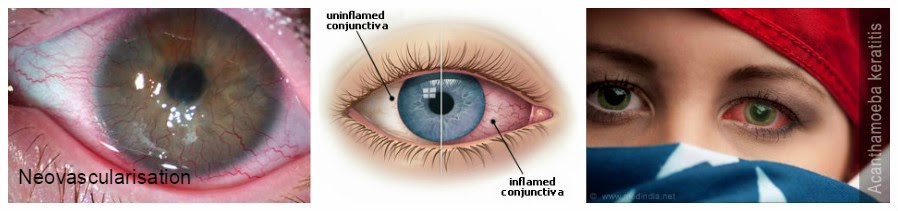
Keratitis is an infection of the cornea- front layer of iris. It can cause blurred & hazy vision leading to permanent vision loss and acute pain along with other deathly symptoms. If you wear contact lenses, you need to stay more vigilant as you are prone to developing ocular infections.


What You Need to Do?

Stay very cautious about your contact lenses. Never allow water to come into contact with your contact lenses. Water contains a virus “acanthamoeba Keratitis” and letting your contact lenses make a contact with water is like welcoming the corneal-devouring parasite to your most precious & only set of eyes. Always air-dry your contact lens cases.

  • How to protect yourself from Conjunctivitis?

Conjunctivitis is the inflammation of the conjunctiva- the white layer of the eye. It is also known as pink- eye disease. It can cause teary eyes, inflammation, itching, irritation, and discharge along with other symptoms.


What You Need to Do?

As a contact lens wearer; you are at a risk of developing conjunctivitis. Therefore, make special preventive measures for the sake of your eyes. Do not share your contact lenses with anyone. Also avoid falling for substandard and cheap contact lenses.

  • How to Protect yourself from Neovascularisation

Neovascularisation occurs when your eyes become oxygen-starved. Since eyes draw its oxygen from the open environment than from the body, they grow blood vessels to fulfill the requirement when there is a blockade. The blood vessels may rupture when you discontinue wearing contact lenses, but in severe cases with excessive growth of blood-vessels you are left with horrendous permanent eye scarring & eye sore.


What You Need to Do?

To prevent your eyes from neovascularisation always take note of following:

Never over-wear contact lenses. This includes wearing contact lenses exceeding the daily limit of 6 hours and wearing contact lenses past their expiry.


Also;
  1. Do not sleep in your contact lenses
  2. Go here to find out if you are also over-wearing contact lenses.

“There is no question that many people love to use contact lenses instead of spectacles. Using contact lenses, however, does carry the risk of infection and, in extreme cases, blindness,” added by CDC team. Always wear FDA approved circle lenses & ensure a pragmatic approach to contact lens disinfection to lead a safe life.

Sunday, 24 August 2014

How common are Acanthamoeba Related Ocular Injuries in Contact Lens Wearers?

Acathamoeba is a corneal devouring parasite found in water. Though acanthamoeba related ocular infections in contact lens wearersare rare, the treatment of the disease is difficult as it takes a period of 27 days in confirmed diagnosis with 33% of patients requiring a corneal transplant.

Acathamoeba leads to potential damages from severe eye pain, redness and itching, stinging, discharge & even to permanent vision loss. Acanthamoeba is associated to poor and unhygienic living standards and is closely related to the exposure of contact lenses with water.


Acanthamoeba Keratitis & Disinfecting Solutions for Contact Lenses

Though the parasite leads to tremendously horrific results; it can be prevented if proper cleanliness & disinfection of contact lenses is observed. It is important to note that not all disinfectants work the same way. A multi-purpose disinfectant with cleanse, rub & disinfecting formula is effective in completely killing off the parasite.

Preventing Acanthamoeba Related Ocular Injuries in Wearers of Contact Lenses

How common are Acanthamoeba Related Ocular Injuries in Contact Lens Wearers?


Few key points help in complete prevention from the parasite.

  1. Never expose your contact lenses to water hence observe restriction in swimming, showering, washing face & other water-based activities whilst wearing contact lenses.
  2. Do not soak or wash your contact lenses with tap water
  3. Wear daily disposable contact lenses if you are clumsy to strictly follow the maintenance of contact lenses
  4. Replace your annual contact lenses after every 8 months whereas replacement of contact lens cases should be made every 3 months.
  5. Air-dry contact lens cases with their faces down and caps off after washing them. Stay very careful about re-immersing contact lenses in their cases whilst they are still wet.

The American Academy of Ophthalmology in conjunction with USFDA is soon to hold a seminar on “Contact Lens Microbiology” where the speakers will discuss the ways of prevention from acanthamoeba related ocular infections & damages in contact lens wearers. Watch this place for more updates & recent technological advancements & treatments on the issue.